What it really costs to import a car to the UAE (we ran the numbers on 4,812).
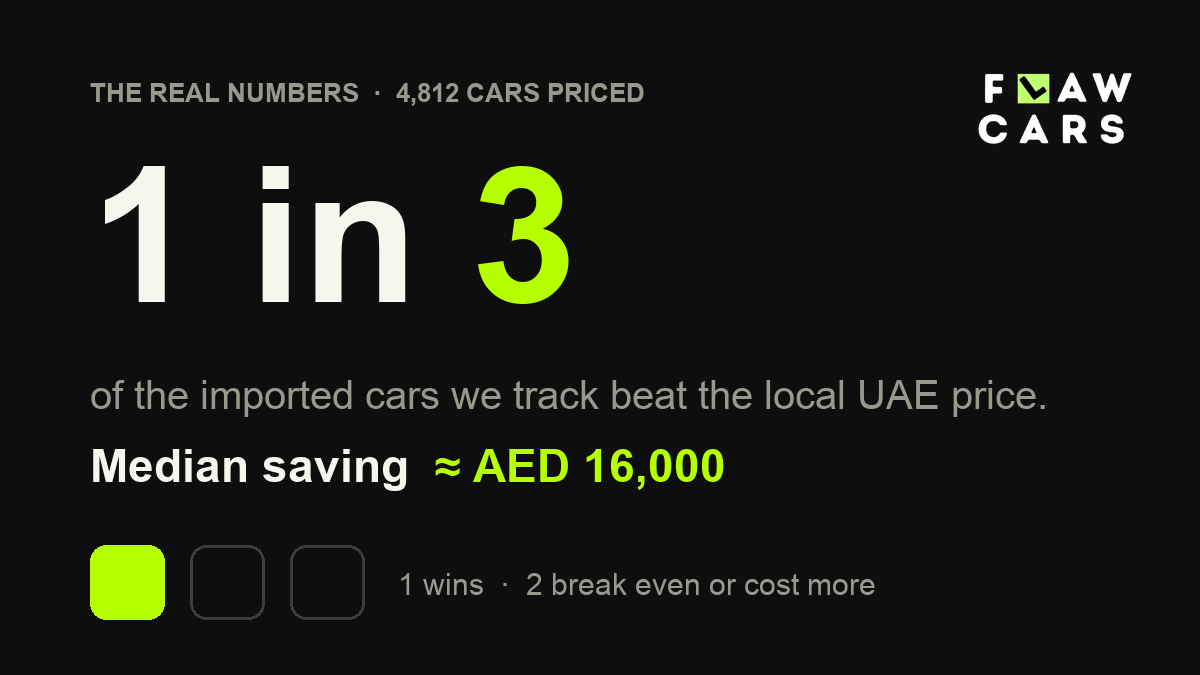
We priced 4,812 used cars we import against the local UAE market. About 1 in 3 land cheaper here after customs, VAT and shipping, a median saving near AED 16,000.


Most articles about importing a car will tell you it's a shortcut to a bargain. It isn't, at least not always. I run Flaw Cars, and we track 4,812 live import cars right now, each one priced against the same car sitting in the local UAE market, so I can tell you exactly how often importing actually wins.
TL;DR: Across 4,812 import cars we track, about 1 in 3 (1,422 cars) land in the UAE cheaper than buying locally, with a median saving of roughly AED 16,000. The other 2 in 3 break even or cost more. Importing is a tool, not a discount. The trick is knowing which car falls in which bucket before you commit.
What actually goes into the landed price of an imported car?
The landed price is the source price of the car plus four fixed additions: 5% UAE customs duty, 5% VAT, shipping, and a clearance fee. Customs and VAT are set by the Federal Tax Authority (UAE Federal Tax Authority, 2023). Everything else is just arithmetic, and it's the same every time.
Here's the formula in plain words. Take the car's price abroad in US dollars and multiply by 3.673 to get dirhams. Add 5% customs and 5% VAT on that value. Add shipping, which runs about AED 5,500 from Korea and AED 4,771 from China. Then add a flat AED 734 for clearance. That total is what the car really costs you, landed on UAE soil, before you've driven a meter.
Numbers are easier to trust than formulas, so here is a real one from our current stock. A 2021 BMW X6 M50i we are importing from Korea, with 67,513 km on it:
| Line item | Amount (AED) |
|---|---|
| Car value (USD 42,712 × 3.673) | 156,881 |
| Customs (5%) | 7,844 |
| VAT (5%) | 7,844 |
| Shipping from Korea | 5,500 |
| Clearance | 734 |
| Total landed cost | 178,803 |
The same X6, matched against a local UAE listing, sits at roughly AED 247,545. So this particular car lands about AED 68,000 cheaper than buying it here. I will be straight with you: that is one of the bigger gaps in our stock right now, not a typical one, and the honest median is a lot smaller (I get to it in the next section). But it shows the shape of a real win. On a high-value car, the fixed import costs are small next to the local markup, and most of that gap is yours to keep. Prices move week to week, so treat it as a genuine snapshot rather than a promise.
So is importing cheaper than buying locally?
Sometimes. Across the 4,812 import cars we track, about 30% (1,422 of them, roughly 1 in 3) land in the UAE below the local market price after every import cost is paid. On those winners, the median saving is around AED 16,000. That's the honest headline, and I'd rather you hear it from me than from a brochure.
Now the part most sellers skip. The other 2 in 3 break even or cost you more. That isn't a flaw in the idea of importing; it's just what happens when you compare thousands of real cars honestly instead of cherry-picking the good ones. Some cars are cheaper abroad. Plenty aren't. What makes the difference is the specific car, the specific market, and how badly the UAE market marks that model up.
So when someone asks me "is importing cheaper," my answer is a question back: cheaper on which car? Averaged across everything, importing is roughly a coin flip with a good upside. Targeted at the right models, it's a reliable saving. That gap, between "everything" and "the right models," is the whole game, and it's where a lot of buyers get it wrong. They import the car they want instead of the car the math likes.
One more thing on that AED 16,000 median. It's a median, not an average, which means half the winning cars save more than that and half save less. A few save very little, just enough to clear the local price. A handful save far more. So don't anchor on 16,000 as a number you're owed. Anchor on the method: price the specific car, then see where it lands.
When importing does NOT save you money
Importing loses money most reliably on cheap cars, because the fixed costs don't shrink with the price. Shipping plus clearance is roughly AED 6,000 to AED 6,300 whether the car is worth AED 30,000 or AED 300,000. On a cheap car, that's a fat percentage. On an expensive one, it's a rounding error.
Think about it. Add AED 6,000 of fixed cost to a AED 35,000 car and you've raised your floor by 17% before customs and VAT even land. The same AED 6,000 on a AED 150,000 car is 4%. This single fact explains most of the cars that fail our comparison. They aren't bad cars. They're just too cheap to absorb the cost of getting them here.
The second trap is GCC-common models. If a car was sold new across the Gulf in big numbers, the UAE is already flush with used ones, and local supply keeps the price low. You'll rarely beat that by shipping one in. And the third trap is the one that costs people the most: paying up for a car you haven't seen. A saving on paper means nothing if the car arrives with a problem you didn't price in. Buying sight-unseen from a photo is how a bargain quietly turns into a repair bill.
Which cars are actually worth importing?
The wins cluster on higher-value cars, because the fixed import costs become a small slice of a big number. That BMW earlier is a clean example: about AED 6,200 of shipping and clearance against a six-figure car barely moves the needle, so the source-price advantage flows almost straight to you.

Beyond price, look for scarcity and markup. Models that are rare in the UAE, or that local dealers mark up hard because supply is thin, are exactly where an importer with the right partners can undercut the market. Most dealers here buy through the same one or two channels, so they all fish the same pond and miss the better cars sitting in Korea, Japan, or elsewhere. That's the gap we work in, and it's why our Korean imports so often come out ahead.
Spec matters too, and in your favour. A well-optioned trim abroad can land cheaper than a stripped-out local car of the same model, which flips the usual logic on its head. When we sort our 4,812 cars by who actually beats the local price, the winners are boringly consistent: higher value, genuine local scarcity, a spec worth having. If a car ticks those three, importing is usually worth a serious look. You can see the ones that currently make the cut among the cars we import.
The costs and risks people forget
The landed-cost math ignores the risks that actually bite, and condition is the big one. At my last company, VerifyBuy, our team inspected more than 5,000 used cars, and the clearest lesson was this: the gap between what a seller knows and what they tell you is exactly where buyers lose money. A car can look perfect in photos and hide a repaired chassis or a tired gearbox.
So price the risks the spreadsheet leaves out. Four of them matter:
- Condition. Photos flatter. Get eyes on the car, ideally a proper inspection, before money moves. This is the single biggest way an import goes wrong.
- Spec and warranty. A non-GCC car may lack a local warranty and can differ in small ways (cooling, software, service intervals). Usually fine, occasionally a real cost, always worth checking.
- Financing and insurance. Both are available for imported cars, but the process is a little more involved than for a car already sitting in a UAE showroom. Budget the extra steps and the time.
- Time. Sourcing, shipping, and registration take weeks, not an afternoon. If you need a car by Thursday, importing isn't your route.
This is where our own model comes from, and I'll be plain that it's how we work rather than a pitch: we inspect every car we import and put what we find in a written flaw report, including the things we'd rather not mention. It won't catch every hidden fault, and I say so openly. But it turns "trust the photos" into "read what's actually wrong," which is the difference between a saving you keep and one that evaporates at the first service.
How importing a car to the UAE actually works
In practice, importing a car follows four steps: source it abroad, inspect it, ship and clear it, then register it locally. The whole path usually runs a few weeks end to end, most of that being shipping time rather than paperwork.
Here's the short version. First, you (or an importer with partners in that country) find the car and agree a price at the source. Second, someone inspects it on the ground, because this is the step that protects the saving. Third, the car ships, arrives at a UAE port, and clears customs, where the 5% duty, 5% VAT, and AED 734 clearance are settled. Fourth, you register and plate it here, sort insurance, and it's yours.
A note on the money at each stage. The source price is settled abroad, the customs and VAT are paid at the port when the car clears, and the registration and insurance costs land once it's here. Nothing is hidden, but the total arrives in pieces over a few weeks, so it's easy to lose track of the running figure. Keep your landed-cost number written down and tick off each cost as it's paid.
None of that is exotic, but each step has a place where a bargain can slip if no one's paying attention: a soft inspection, a spec surprise at customs, a registration delay. Doing it yourself is entirely possible. Handing the messy middle to someone who does it daily is the other option, and it's roughly how buying with us works.
The bottom line
Importing a car to the UAE is a tool, not a guaranteed discount. On the numbers, about 1 in 3 of the 4,812 cars we track beat the local price, with a median saving near AED 16,000, and the other 2 in 3 don't. Whether it's worth it comes down entirely to which car you're looking at.
So run the math before you fall for the idea. Check the source price, add the 5% customs, 5% VAT, shipping, and AED 734 clearance, and compare that landed number to what the same car costs here. If it's cheaper and it's a car worth wanting, import it. If it isn't, buy local and save yourself the wait. And whichever way you go, get the car inspected. A saving you can't verify isn't really a saving; it's a bet.
If you'd like to skip the math, browse the cars we import to see the ones that currently beat the local price, or the certified clean cars we've already vetted if you'd rather buy something inspected and ready to drive today.
FAQ
Is importing a car to the UAE legal?
Yes. Importing a used car into the UAE is entirely legal, provided you pay the 5% customs duty and 5% VAT and complete registration (UAE Federal Tax Authority, 2023). The main rules concern the car's age, condition, and spec meeting local standards. Working through an importer who does the paperwork daily keeps it straightforward.
How long does importing a car take?
Usually a few weeks from start to finish, with most of that being shipping time rather than paperwork. Sourcing and agreeing the car can be quick; the sea freight and port clearance are the slow parts. If you need a car within days, importing isn't the right route, and buying a local or already-vetted car makes more sense.
Can I finance and insure an imported car?
Yes, both are available for imported cars in the UAE. The process is a little more involved than for a car already in a local showroom, since lenders and insurers may want documentation on the imported vehicle first. Budget for a few extra steps and a little more time, then it works much like financing any used car here.
GCC vs non-GCC spec, does it matter?
Sometimes, and it's worth checking before you buy. GCC-spec cars are built for Gulf conditions and usually carry a local warranty, while non-GCC imports occasionally differ in cooling, software, or service intervals. Most non-GCC cars run perfectly well here. But knowing the spec up front means no surprises at registration or at your first service.
Are Korean-market used cars reliable?
Broadly, yes, which is a big reason we source so many from there. Korean-market cars are often well-maintained, cleanly documented, and priced below what the equivalent sells for in the UAE. The key, as with any import, is a proper inspection on the ground before shipping. You can see our current stock among our Korean imports.